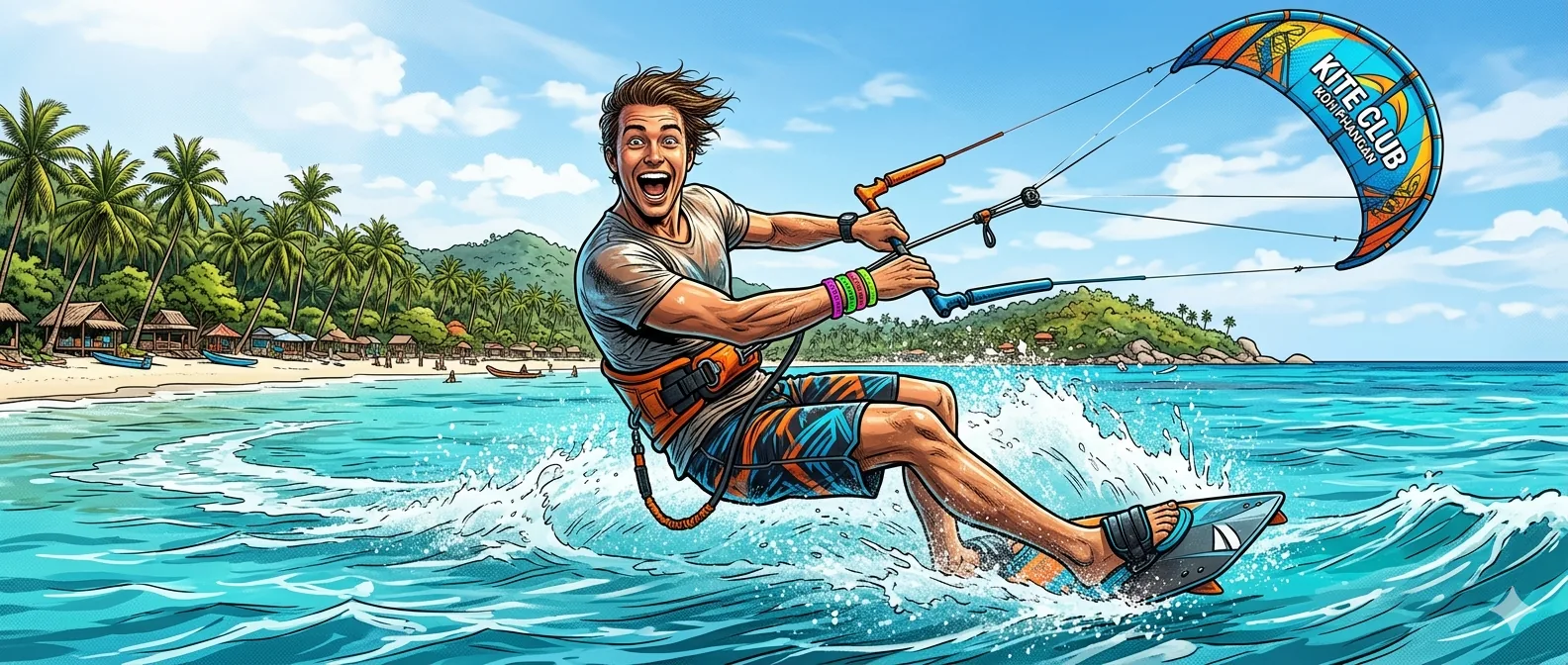
Riding upwind is the skill that turns a beginner into an independent kitesurfer. Without it, every session ends with a walk back along the beach. The technique comes down to four things: edge, kite position, stance and speed.
📖 3 min read · Updated September 2026 · By Sergei Sharvarok · Founder & Head Instructor
1. Edge the Board
Upwind riding comes from the board, not the kite. Dig the heel-side rail into the water so the board grips and resists the pull. Think of the board slicing across the wind rather than skating flat on top of it.
2. Keep the Kite Lower and Steady
Park the kite at roughly 45° above the water on your riding side — around eleven or one o'clock, depending on direction. Too high and it pulls you up instead of forward; constant diving makes you drift downwind. A steady kite with small corrections is the goal.
3. Stance and Weight
- More weight on the back foot, front leg slightly straighter.
- Hips pushed forward, shoulders open towards where you are going.
- Look upwind — at a point ahead of you, not at the kite or the board.
- Keep your arms relaxed; let the harness take the load.
4. Enough Speed
An edging board needs speed to work. If you point too high into the wind, you stall and sink. Build speed on a slightly downwind line first, then gradually edge harder and point higher while the board is fast.
Common Mistakes
- Standing up straight — you lose the edge and get pulled downwind.
- Kite too high — lots of lift, no forward drive.
- Sheeting in too much — the kite stalls and the board slows.
- Always the same direction — many riders go upwind well on their strong side only. Practise both.
Pick a landmark on the beach before you start and check it at the end of each run. It is the simplest honest measure of whether you are really gaining ground.
Two Simple Drills
- Edge-and-release — ride, edge hard for five seconds, flatten, repeat. You feel exactly how the edge creates upwind drive.
- Short tacks — ride short legs in both directions and aim to finish each one level with or above your start point.
Practising on Koh Samui
Flat water makes upwind riding much easier to learn. Nahai Beach (December–April) has shallow, flat water and a steady NE to E–SE wind — ideal for building the edge. Upwind riding is a core part of our Independent course (20,000 THB), coached through radio helmets so you get corrections while you ride.
Frequently Asked Questions
Why can I not ride upwind kitesurfing?
Usually the board is not edged enough, the kite is too high or you are pointing too high without speed. Build speed first, then edge harder.
Where should the kite be to go upwind?
Roughly 45° above the water on your riding side, held steady with small corrections.
Does board size matter for riding upwind?
A board that is too small for your weight and the wind makes it harder. In light wind, a bigger board or a bigger kite helps.
Which course teaches upwind riding?
The Independent course at Kite Club Koh Samui — 10 hours private or 15 hours in a group, 20,000 THB.
Nail Your Upwind Riding
Radio-helmet coaching turns weeks of trial and error into a few sessions.
💬 WhatsApp +66 99 312 9042